
Southeast Regional Cybersecurity Collaboration Center
Advancing operational technology cybersecurity research, demonstration and transition for the energy sector
About SERC3
The Southeast Region Cybersecurity Collaboration Center (SERC3), led by Auburn University’s McCrary Institute for Cyber and Critical Infrastructure Security, brings together utilities, national laboratories, academic researchers, government partners and industry stakeholders to strengthen cybersecurity resilience across critical energy infrastructure.
SERC3 is designed as an applied research, development and demonstration initiative focused on operational technology cybersecurity. Through its regional utility engagement model and high-fidelity Edge Lab environment, SERC3 helps evaluate cybersecurity technologies, generate practical evidence and accelerate the transition of validated approaches into utility workflows.
Building on its initial foundation, SERC3 is expanding its work to address current energy-sector cybersecurity priorities, including supply chain visibility, Defense Critical Energy Infrastructure assessment and hardening, AI-enabled cyber defense, operational technology datasets and pilot demonstrations of emerging cybersecurity capabilities.
Program partners

SERC3 is led by Auburn University’s McCrary Institute for Cyber and Critical Infrastructure Security and works with Oak Ridge National Laboratory, regional utilities, government partners, academic researchers and industry stakeholders.
The McCrary Institute combines policy, technical and convening expertise to address critical infrastructure security challenges. Oak Ridge National Laboratory brings deep technical capabilities in grid security, cyber-physical systems, modeling, analytics and applied research.
Industry engagement
SERC3 is industry-informed and operationally grounded. Utilities and industry partners help shape research priorities, provide operational perspective, participate in advisory and technical working groups, and support the transition of validated cybersecurity approaches into utility environments.
Program funding
The funding for the program is $12.5 million.
$10M
Awarded from U.S. Department of Energy (DOE) Grant
$2.5M
Provided by Auburn University and other strategic partners
Program overview
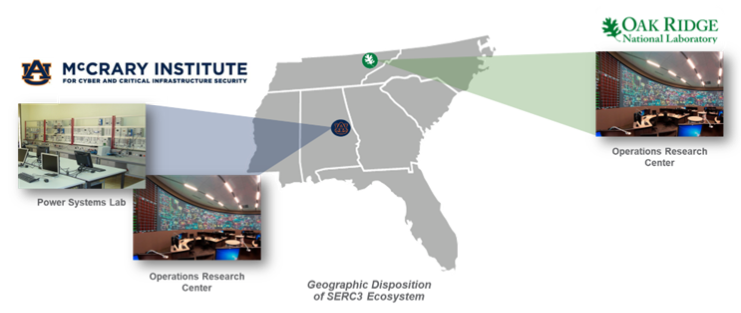
SERC3 serves as a regional, operator-informed bridge between cybersecurity research, laboratory validation and real-world utility adoption. The program focuses on practical cybersecurity challenges affecting energy delivery systems and other critical infrastructure environments.
SERC3’s work includes:
- Engagement with utilities and industry partners to support technology transition, workforce development and adoption pathways for under-resourced utilities.
- Hardware and software enumeration of operational technology equipment in support of DOE supply chain security priorities.
- Development of Hardware Bills of Materials and Software Bills of Materials for approved priority equipment.
- Assessment and hardening support for Defense Critical Energy Infrastructure.
- Evaluation of AI-enabled cybersecurity tools, workflows and models for safe, auditable, human-authorized use in operational technology environments.
- Development of labeled operational technology cybersecurity datasets to support analysis, detection development and information sharing.
- Threat-informed pilots and demonstrations of cybersecurity technologies in representative utility IT/OT environments.
SERC3 Edge Lab
The SERC3 Edge Lab provides a high-fidelity environment for operational technology cybersecurity research, testing, evaluation and demonstration. The lab allows researchers, students, utilities, technology providers and government partners to examine cybersecurity challenges in realistic energy-sector environments without creating risk to operational systems.
The Edge Lab supports:
- Representative utility IT/OT environments
- Hardware and software enumeration activities
- OT telemetry and dataset generation
- AI-assisted incident response and cyber-defense evaluation
- Emerging technology pilots
- Utility-focused demonstrations and stakeholder feedback sessions
- Workforce development and applied student engagement
Current focus areas
Supply chain security and OT asset visibility
SERC3 supports supply chain security through hardware and software enumeration of approved operational technology equipment. This work includes the generation of HBOMs, SBOMs and associated reporting to improve visibility into the hardware and software components that support critical energy infrastructure.
Defense critical energy infrastructure assessment and hardening
SERC3 works with partners to support structured assessment and hardening activities for critical energy infrastructure. This work focuses on identifying cybersecurity risks, developing mitigation approaches and helping utilities strengthen resilience against current threat patterns.
AI-enabled cyber defense and assurance
SERC3 evaluates AI-enabled cyber-defense tools, workflows, models, platforms and agentic capabilities for operational technology cybersecurity. The program emphasizes safe, auditable, human-authorized AI support for incident response and operational decision-making.
OT cybersecurity datasets and threat-informed evidence
SERC3 develops operational technology cybersecurity datasets and supporting documentation to help improve analysis, detection development, model evaluation and information sharing. Where appropriate, test scenarios are mapped to current threat activity, utility-prioritized consequence scenarios and operationally relevant cybersecurity outcomes.
Emerging technology pilots and utility transition
SERC3 identifies and pilots cybersecurity technologies that address energy-sector needs. Demonstrations are designed to evaluate technical capability, interoperability, deployability, operator workload, safety constraints, sustainment burden and suitability for adoption by utilities, including under-resourced utilities.
SERC3 objectives
- Strengthen operational technology cybersecurity for the energy sector.
- Support supply chain visibility through hardware and software enumeration.
- Generate threat-informed, reproducible evidence for DOE, utilities and other stakeholders.
- Evaluate AI-enabled cyber-defense capabilities in controlled, operationally relevant environments.
- Develop datasets, playbooks and lessons learned that support energy-sector cybersecurity.
- Accelerate technology transition from research and demonstration into deployable utility workflows.
- Expand workforce development opportunities for students, researchers and practitioners.
- Support under-resourced utilities through practical adoption pathways and regional collaboration.
Our team
SERC3 is led by Auburn University’s McCrary Institute for Cyber and Critical Infrastructure Security, with participation from Oak Ridge National Laboratory, Auburn faculty and researchers, Edge Lab technical staff, students, industry advisors and utility partners.
News and updates
Auburn’s McCrary Institute and Oak Ridge National Laboratory to partner on first regional cybersecurity center to protect the nation’s electricity grid
Published: April 18, 2024
Contact us
Are you interested in learning more about our program?
For program inquiries, partnership opportunities or information about SERC3 activities, please contact the SERC3 Program Team.
Partnership opportunities:
- Participate in SERC3 Industry Advisory Board or technical working groups
- Provide operational perspective on cybersecurity priorities
- Support pilot demonstrations or technology evaluation
- Engage with Edge Lab research and demonstration activities
- Mentor students and emerging OT cybersecurity professionals
- Collaborate on workforce development and technology transition
Benefits of involvement:
- Help shape applied OT cybersecurity research priorities
- Engage with a realistic testbed for critical infrastructure cybersecurity
- Support development of practical cybersecurity solutions for utilities
- Access lessons learned from threat-informed pilots and demonstrations
- Strengthen the future OT cybersecurity workforce
- Contribute to regional and national critical infrastructure resilience


